In this series, we have explored the pitfalls that cause many DeepTech projects to fail: the Lab Trap, the Prototype Wall, and the Alignment Gap.
The problem is clear: 1D teams (pure PhDs) see the complex mathematical world but often miss the machine and business requirements. 2D teams (research plus classical engineering) can translate their research into code but often get lost in the labyrinth of procurement, regulation, and the strategic imperatives of large-scale industrial or public sector projects.
Why 3D Leadership is Essential for DeepTech Projects
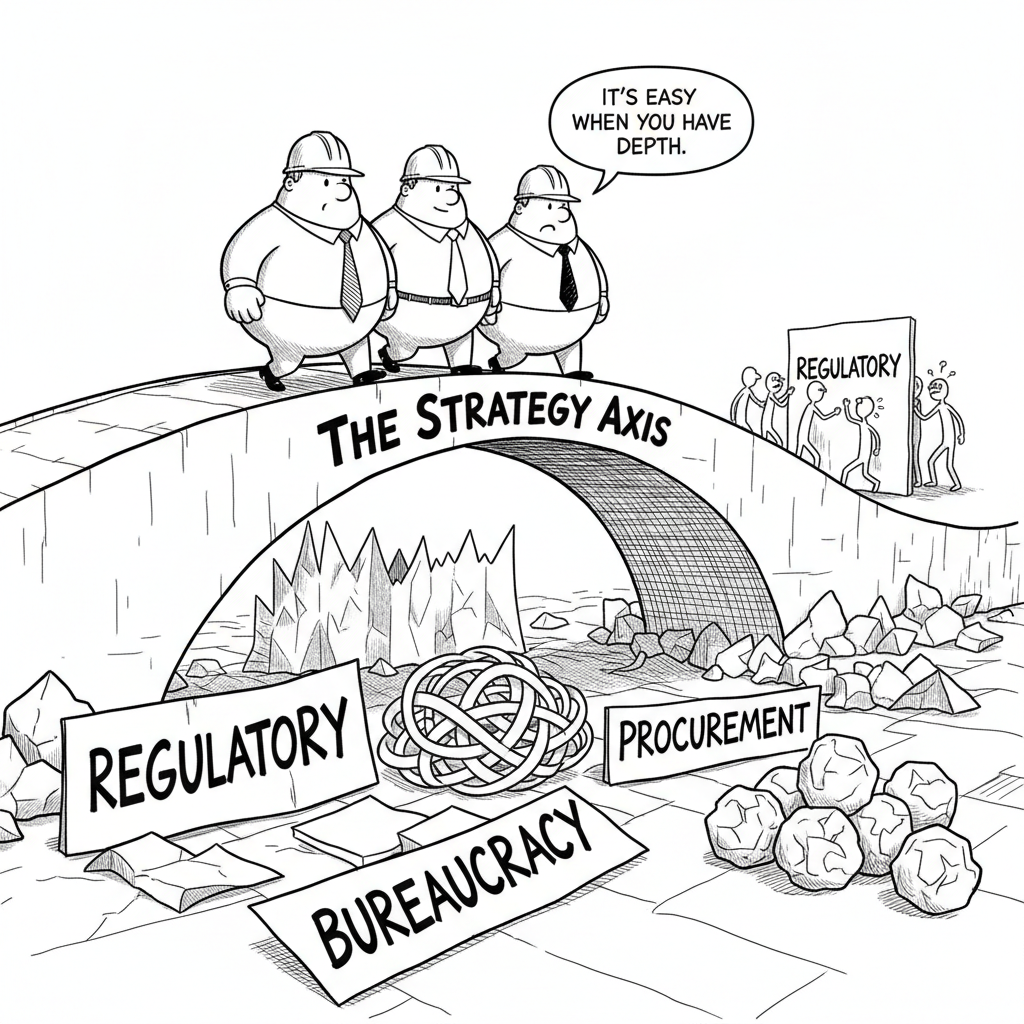
This is precisely where a 3D Leadership Structure comes into play. You should not navigate on a flat map or a single axis, but in a full volumetric space that encompasses all critical coordinates:
- Depth (X-axis): The scientific excellence and mathematical foundation required to understand and solve the core problems of DeepTech.
- Breadth (Y-axis): The robust technical implementation, from the Linux kernel to distributed systems, ensuring that solutions run with high performance and stability even under real-world conditions.
- Height (Z-axis): The strategic alignment and process steering to seamlessly integrate technical solutions into business processes, secure budgets, communicate with procurement departments, and deliver tangible business value.
It requires the Architectural Validation that DeepTech innovations need to avoid dissipating into the digital ether. Because the real world is more than a calculation or a codebase – it’s a mission-critical deployment environment where failure has consequences.
The BCG/BDI study’s recommendations on cooperation and strategic goals are crucial, but they require volumetric implementation capacity to truly make an impact.
So don’t just solve the math; but build the infrastructure and secure the strategic path to production. This ensures that DeepTech innovation lands exactly where it creates real value: at the heart of German industry and public administration.